


ARC Research Free Enterprise and Good Governance
Free Enterprise and Good Governance
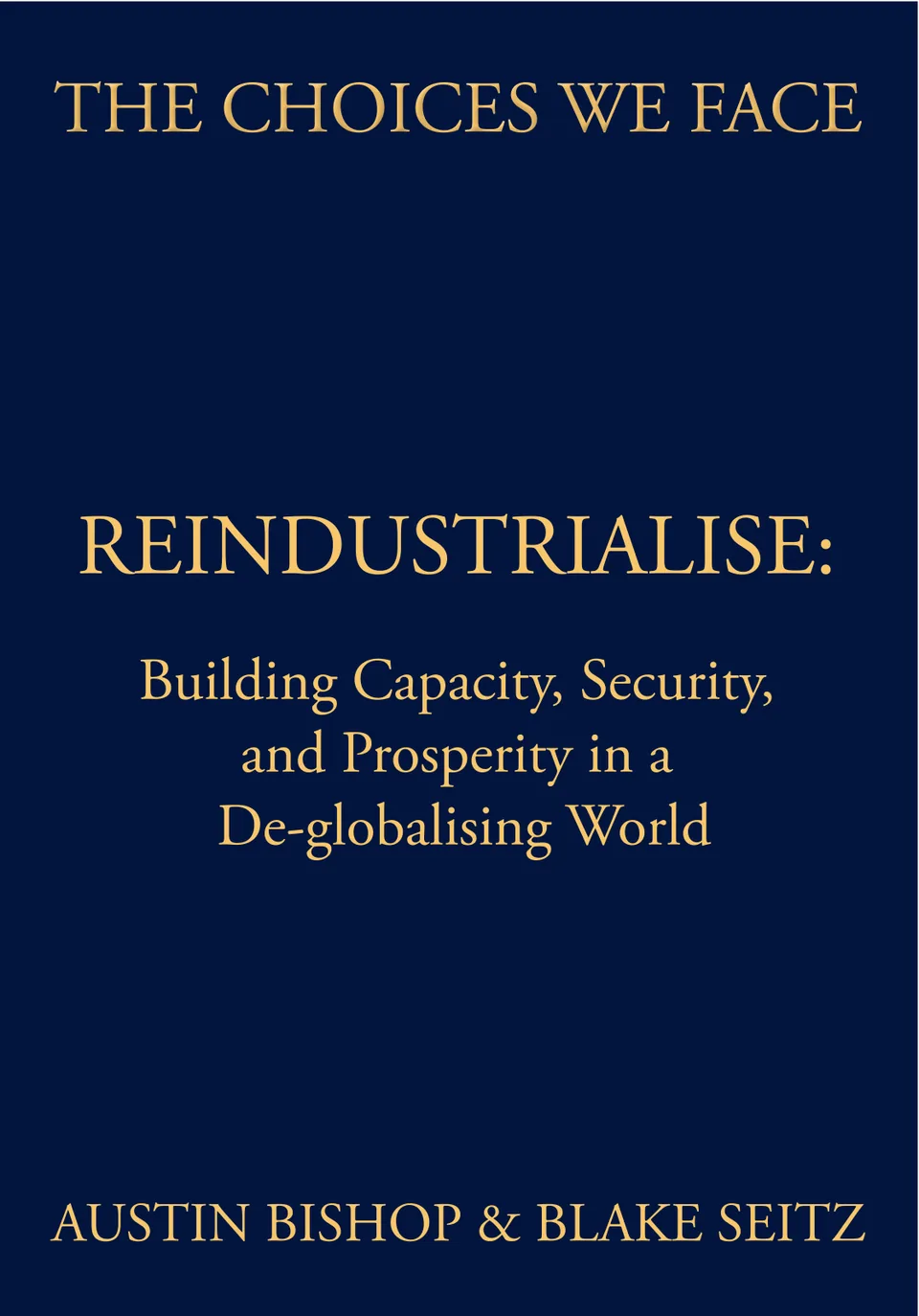
Reindustrialise: Building Capacity, Security, and Prosperity in a De-globalising World
Austin Bishop and Blake Seitz
35 pages · 2025 · The Choices We Face
Summary
Deindustrialisation has resulted in the decline of many of our great manufacturing cities across the United States, United Kingdom, and Europe over the past half century or more. The so-called “Rust Belt” in the United States—once a great industrial centre—now evokes terms such as “urban blight” and “deaths of despair”.
This decline in our ability to manufacture goods in abundance has not only resulted in job losses, urban decay, and social dysfunction. It has also led to over-reliance on supply chains in foreign powers which has left us weakened in our ability to deter aggression or effectively support our allies. Overall, this weakens entire countries and threatens our civilisation.
Industrial decline was a choice, a consequence of bad policy decisions and flawed ideology. Since the 1960s, over-regulation and the added cost of energy has made the construction of industrial plants slow, difficult, and expensive. Uncompetitive business environments at home led to waves of plant closures, and the outsourcing of production overseas. The combination of overregulation and globalisation conspired to cause our industrial decline and have reshaped Western economies and the incentives that determine business investment, productivity, and growth.
Recent global crises—notably the COVID-19 pandemic, Russia’s war in Ukraine, and attacks on merchant shipping in the Red Sea—have demonstrated the dangers of dependency on manufacturing in China, or energy supplies from Russia, and the fragility of global supply chains. The West’s reduced manufacturing capabilities has meant our inability to make weapons in the quantities needed to win a modern war.
The pursuit of a successful reindustrialisation agenda will require facing up to past and present mistakes and addressing the root causes of overregulation and globalisation that have made Western industry uncompetitive. It will also require the following five steps:
- Serious deregulation and reform, to facilitate industry;
- A proactive industrial policy and changes to the incentive structure for investment in manufacturing;
- Rapid deployment of new sources of energy to suppress the price of electricity for industrial customers;
- Investment in engineering and vocational training, to recreate a viable manufacturing workforce;
- Serious action to diversify supply chains, ending dependency on China and strengthening trading relationships with like-minded democracies.
None of these steps are easy and none can be achieved overnight. They will require policy changes, public support, and capital investment. Entrepreneurs and innovators need to be encouraged to lead us out of our present malaise. But the potential for industrial renewal is there, if we make new and better choices.
More in Free Enterprise and Good Governance
 Free Enterprise and Good Governance
Building Economic Dynamism: Can the West Grow Again?
David Frost · 24 pages Free Enterprise and Good Governance
Freedom of Speech and Big Tech: Liability and Regulation
Michael Shellenberger · 137 pages Free Enterprise and Good Governance